Many organizations are now asking the same question: How do we use AI to improve productivity, reduce cost, and move faster?
It is the right question, but it is often asked too late in the conversation.
By the time leadership teams discuss AI, the discussion has already moved toward tools, licenses, pilots, platforms, vendors, and use cases. Someone wants a chatbot. Another team wants automation. A department wants AI-assisted reporting. The technology conversation becomes active very quickly.
But there is a quieter question that should come first:
Are we clear enough as an organization to benefit from AI?
This may sound simple, but it is one of the most important issues in any AI strategy. AI does not automatically fix unclear work. In many cases, it exposes it.
If decision rights are vague, AI will accelerate confusion. If processes are inconsistent, AI will automate inconsistency. If data ownership is unclear, AI will create governance tension. If accountability is weak, AI will make mistakes harder to trace. If teams do not agree on what good output looks like, AI will produce more output without improving business quality.
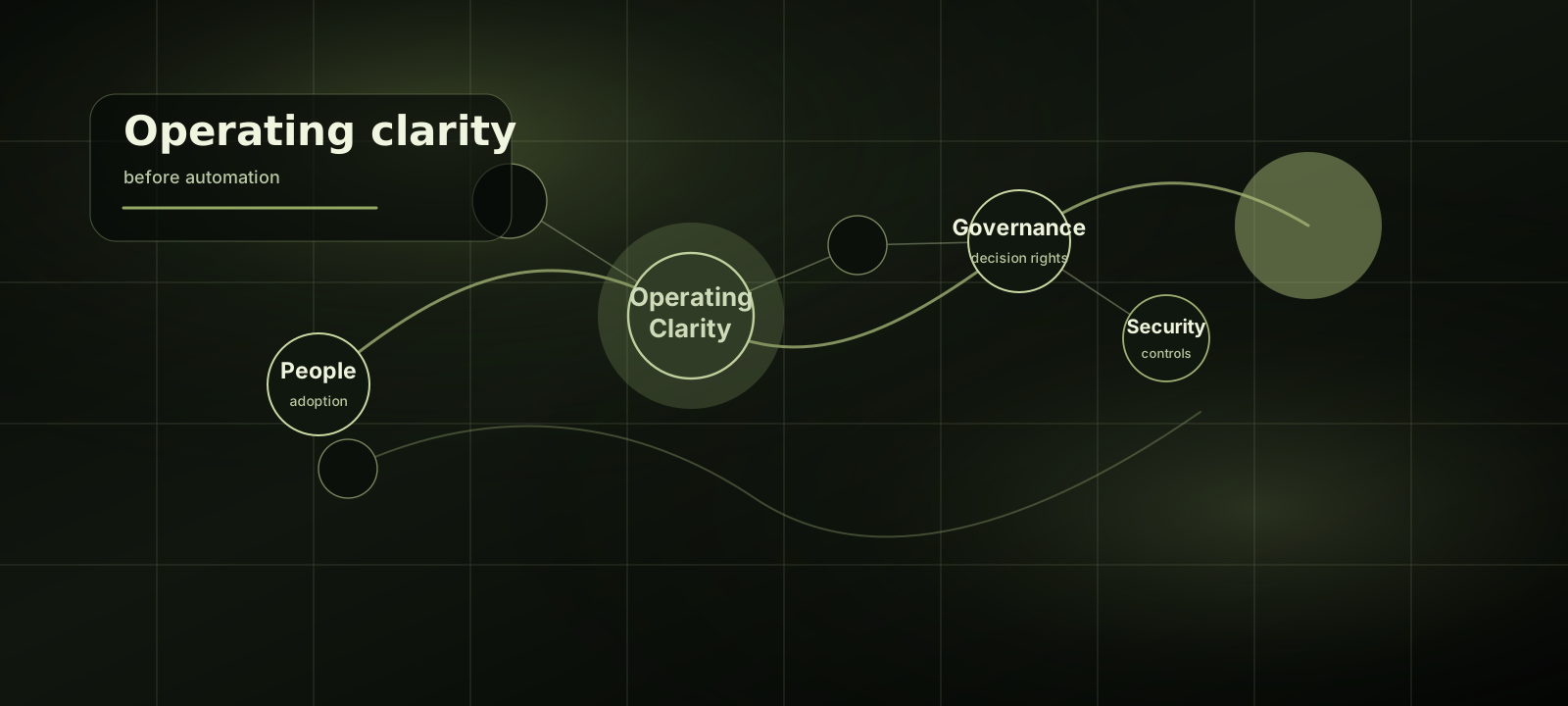
That is why operating clarity should be treated as a core layer of AI strategy, not as a side activity.
AI is not just a technology shift
AI is usually introduced as a technology capability, but its real impact is operational. It changes how people search for information, write documents, analyze data, serve customers, monitor risks, make decisions, and interact with systems.
This means AI affects the way work moves across the organization.
A practical AI strategy therefore needs to answer more than, "Which tools should we buy?" It should also answer:
- Who owns the business outcome?
- Who approves AI-assisted outputs?
- Which tasks are suitable for automation, assistance, or human-only handling?
- What data can be used, and under what conditions?
- How do we measure quality, risk, and value?
- What happens when AI is wrong?
- Where must human judgment remain visible?
Without these answers, AI adoption becomes fragmented. Teams experiment in different directions. Some use approved platforms, others use personal tools. Some use AI for low-risk productivity tasks, while others quietly use it for sensitive work. Over time, the organization may gain activity, but not maturity.
This is why governance cannot be separated from execution. It must be built into the operating model.
The real risk is not only misuse
Many AI governance discussions focus on misuse: data leakage, hallucination, bias, regulatory exposure, or unauthorized tools. These are real risks and must be managed.
But there is another risk that receives less attention: unclear use.
Unclear use happens when employees are not sure when AI is allowed, how it should be used, what needs approval, or how to validate the output. In this environment, even well-intentioned employees may create risk.
A manager may use AI to summarize internal reports without knowing whether the data is suitable. A team may generate customer communication without proper review. An analyst may rely on AI-generated insight without checking the source. A department may build a useful workflow that cannot be scaled because no one considered security, integration, or ownership.
The issue is not always bad behavior. Often, it is lack of clarity.
Good AI governance should therefore be practical and easy to understand. It should not be a long policy document that employees rarely read. It should provide clear direction for daily work.
A useful governance model tells people:
- What is allowed.
- What is restricted.
- What needs approval.
- What must be reviewed by a human.
- What data should never be entered.
- Who to contact when unsure.
- How AI-supported work should be documented.
This is where leadership communication matters. If the message is too technical, employees will ignore it. If the message is too restrictive, innovation will move underground. If the message is too vague, every team will create its own interpretation.
The goal is not to slow AI adoption. The goal is to make it safe enough, clear enough, and trusted enough to scale.
Start with workflows, not tools
A practical way to build AI strategy is to start with workflows.
Instead of asking, "Where can we use AI?" leaders can ask:
Which workflows are currently slow, repetitive, unclear, or decision-heavy?
This changes the conversation. It moves AI from being a technology experiment to being an operating improvement tool.
Some workflows may benefit from AI assistance, such as drafting, summarizing, classifying, searching, or preparing first versions of reports. Others may require stricter controls, especially where legal, financial, cybersecurity, HR, customer, or regulatory impact is involved.
Not every process should be automated. In some cases, the better answer is to simplify the process first. AI should not be used to hide poor process design. If a workflow has too many approvals, unclear ownership, duplicated data entry, or conflicting reports, automation may only make the weakness move faster.
The sequence matters:
- Clarify the business objective.
- Map the workflow.
- Identify pain points and risk points.
- Decide where AI can assist.
- Define human review and accountability.
- Measure value and quality.
- Scale only after learning.
This approach keeps AI connected to business value. It also makes governance easier because controls are linked to real work, not abstract policies.
Cybersecurity leadership has a key role
AI strategy is not only an IT or innovation topic. Cybersecurity leadership has an important role because AI changes the organization's exposure.
Employees may use AI tools with sensitive information. AI-enabled applications may connect to internal systems. Vendors may introduce AI features into platforms already used by the business. Attackers may use AI to improve phishing, impersonation, and social engineering.
But the cybersecurity role should not be limited to saying "no." Security leaders should help the organization adopt AI with confidence.
This means providing practical guidance, risk classification, secure patterns, and review mechanisms. It also means working with business teams early, before AI use cases become shadow projects.
A strong security position is not anti-innovation. It creates the conditions for responsible innovation.
The most effective cybersecurity leaders will help answer:
- Which AI use cases are low, medium, or high risk?
- Which data categories are approved or restricted?
- What controls are needed for enterprise AI tools?
- How should identity, access, logging, and monitoring work?
- How do we assess AI vendors?
- How do we respond if AI creates a security or privacy incident?
This turns security from a gatekeeper into an enabler of trusted adoption.
Executives need a simple operating model
For AI to scale, executives need a simple operating model that people can follow.
It does not need to be complicated. In fact, if the model is too complex, it will fail. A practical AI operating model can start with five elements:
- Direction: What are we trying to achieve with AI, and where should teams focus first?
- Ownership: Who owns AI strategy, governance, platforms, data, security, and business outcomes?
- Use case management: How do ideas get submitted, reviewed, prioritized, tested, and scaled?
- Controls: What rules apply to data, privacy, cybersecurity, compliance, human review, and vendor risk?
- Measurement: How do we measure productivity, quality, adoption, risk reduction, and business value?
These elements help the organization move from scattered experimentation to managed execution.
They also give employees confidence. People are more likely to use AI responsibly when they understand the boundaries. Managers are more likely to support adoption when they understand the accountability. Executives are more likely to invest when they can see value and control together.
Clarity comes before scale
The organizations that benefit most from AI will not necessarily be the ones that buy the most tools. They will be the ones that create clarity around how AI fits into the way they work.
AI can improve speed, quality, analysis, service, and decision-making. But it needs structure around it. It needs clear ownership. It needs good governance. It needs practical security. It needs leaders who can connect technology to business operations.
Before asking how much AI can automate, organizations should ask how clearly they operate today.
AI does not remove the need for leadership clarity. It increases it.